
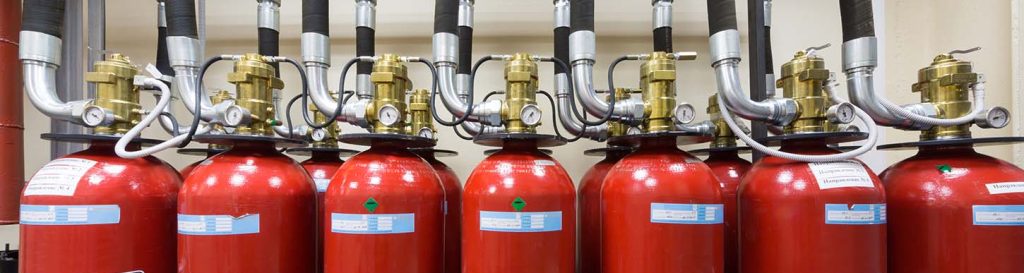
Clean Agent Fire Suppression Systems
B-Lann Equipment installs and/or services a range of Ansul clean agent fire suppression systems:
- Sapphire (install, inspect, and service)
- Inergen (install, inspect, and service)
- High Pressure CO2 (install, inspect, and service)
- Low Pressure CO2 (inspect and service)
A clean agent fire suppression system is a gas-based active fire protection solution designed to suppress fires in enclosed spaces without harming sensitive equipment or leaving behind any residue. These systems use electrically non-conductive, non-corrosive, and non-toxic chemical gases to provide quick suppression, making them the preferred choice for spaces where high-value items are kept.
How Clean Agent Fire Suppression Systems Work
Clean agent systems store the extinguishing gas (such as FM-200) in pressurized cylinders. When fire is detected, the agent is discharged into the protected space, achieving fire suppression in two ways:
- Heat absorption (primary). The chemical gas agent works at the molecular level to absorb heat energy from the fire. By rapidly removing the heat, the gas interrupts the burning process and suppresses the fire before significant damage occurs.
- Chemical inhibition (secondary). Some clean agents also interfere with the chemical chain reaction of the fire, reinforcing the suppression effect.
Because the agent is a gas that dissipates after discharge, it’s extremely effective against Class A (surface level), Class B (flammable liquids), and Class C (electrical) fires in total flood applications.
Industries and Situations Where Clean Agent is Used
Clean agent systems are used in environments where the value of data, electronics, or irreplaceable documents far exceeds the cost of the system itself, and where operations need to run continually. They are commonly used in:
- Data centers and server rooms. Protecting information technology infrastructure, network racks, and telecommunications equipment.
- Museums and archives. Safeguarding irreplaceable historical documents, artwork, and cultural artifacts from both fire and water damage.
- Telecommunications facilities. Protecting switching centers and control rooms vital for maintaining communication networks.
- Control rooms and high-tech manufacturing. Shielding expensive machinery, robotic arms, and complex control consoles that cannot tolerate liquid residue.
- Medical facilities. Protecting sensitive diagnostic equipment and clean rooms.
The Importance and Benefits of Clean Agent Systems
The importance of a clean agent system is in its ability to suppress a fire without the necessity of a cleanup period, allowing the facility to resume operations almost immediately.
- Zero residue. The gaseous agent evaporates completely, leaving behind no water, powder, or oily residue that could damage electronics or require lengthy and expensive cleaning.
- Speed of suppression. Suppression typically happens within 10 seconds of discharge, providing protection and minimizing fire damage.
- Ozone friendly. Modern clean agents have an extremely low, or zero Ozone Depletion Potential (ODP), making them environmentally responsible.
Required Maintenance for Clean Agent Fire Suppression Systems
Maintenance for clean agent systems is highly technical and must be performed by highly-trained and certified professionals to guarantee the system’s ability to work correctly.
- Semi-annual inspections. A certified B-Lann technician conducts a thorough inspection of all mechanical and electrical components every six months. This includes verifying the functionality of the detection system, control panel, and release circuits.
- Pressure and weight verification. The technician must check the pressure gauge on the agent cylinders and verify the weight of the clean agent within the cylinder. Any loss of pressure or mass below the manufacturer’s specified limit requires immediate servicing and recharging.
- System integrity check. The room is visually checked for any unsealed holes or breaches that would compromise the agent’s ability to maintain the necessary concentration after discharge.
- Cylinder hydrostatic testing. The storage cylinders must undergo a hydrostatic pressure test at intervals set by local code or manufacturer requirements (typically every 5 or 12 years). Clean agent cylinders follow CGA (Compressed Gas Association) standards while they’re in service. Under these standards, a successful 5-year visual inspection allows them to remain in service indefinitely. The moment they discharge, they must be transported for servicing and refilling. At that point, the cylinders fall under DOT (Department of Transportation) standards, which requires them to be tested every 5 years.
Following any discharge, the system must be immediately re-filled with the exact mass of the agent and certified before the space can be considered protected again.
Installation Process for Clean Agent Fire Suppression Systems
Installation of a clean agent system requires highly specialized engineering to make sure the correct concentration of gas is delivered rapidly throughout the area. This process needs to strictly adhere to NFPA 2001 standards.
- Design and planning:
- Volume and leakage assessment. An engineer must precisely measure the room’s volume and perform a door fan test to assess the room’s integrity (how quickly the agent will leak out).
- Concentration calculation. Using the volume and room integrity data, the engineer calculates the exact mass of the agent needed to achieve the necessary suppressing concentration for the specified minimum holding time.
- Blueprint approval. Detailed drawings for the cylinder placement, piping, and nozzles are created and must be approved by the local authority having jurisdiction (AHJ).
- Component setup:
- Cylinder installation. The agent cylinders are securely mounted, often in a dedicated storage area next to the protected area.
- Piping and nozzles. Precision-cut piping is installed, leading to specialized discharge nozzles that are designed to deliver a uniform, rapid discharge of the gas throughout the entire room.
- Detection and control. Advanced detection systems (often using cross-zone smoke detection) are wired to a control panel and the cylinder valve mechanism.
- Finalization:
- Discharge test. Following installation, B-Lann technicians perform a discharge test using an analyzer to verify the correct concentration levels are reached and maintained within the specified time limits.
- Certification. All detection and release systems are electronically tested and verified, and the system is officially certified as operational.